Climate Chart of Death Valley National Park, USA
Monthly data: Temperature °C, Rain (mm), Sunshine (h) · 2013–2023
For Death Valley National Park, USA, the climate data describe 2013–2023. The monthly mean temperature ranges from December at 6.2 °C to July at 28.7 °C, giving a broad picture of how conditions vary across the year. Rainfall and sunshine also have distinct monthly peaks, while the recorded snowfall figures remain daily means rather than measures of snow cover or winter recreation conditions.
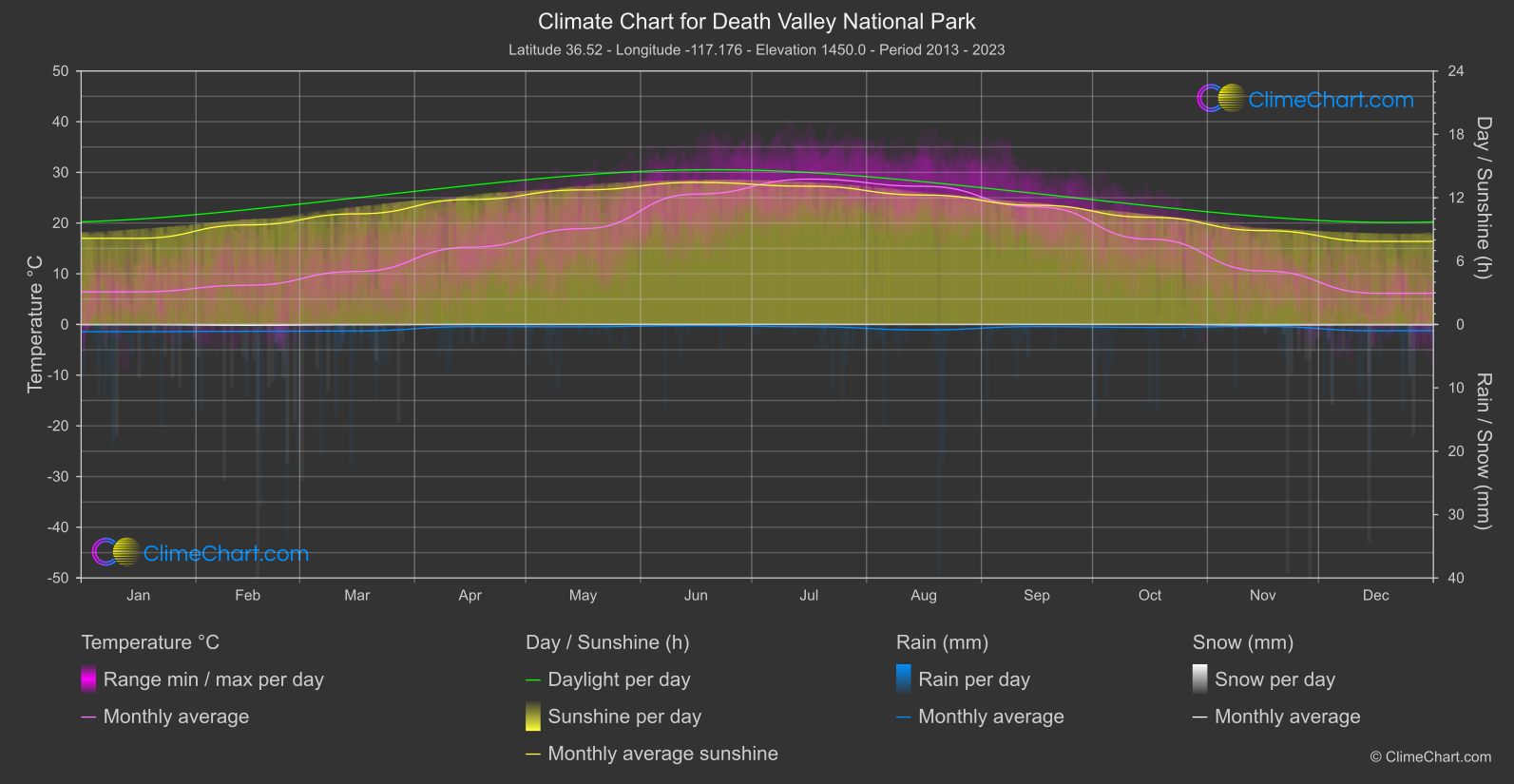
Climate overview
Temperature
The coolest monthly mean temperature occurs in December, at 6.2 °C; the warmest is in July, at 28.7 °C. These are monthly averages, not daytime highs or lows, so they describe the general temperature level rather than the range visitors might experience within a day. Across the calendar-month means, the unweighted mean is 16.4 °C.
Rain
Mean daily rainfall is highest in January, at 0.57 mm/day, and lowest in June, at 0.09 mm/day. The unweighted mean across monthly means is 0.31 mm/day. These figures are daily averages, not monthly totals, and they do not show how often rain falls or guarantee dry weather in the lower-rainfall month.
Sunshine
Mean daily sunshine reaches its highest level in June, at 13.45 hours/day, while the lowest monthly mean is in December, at 7.86 hours/day. The unweighted mean across monthly means is 10.80 hours/day. Sunshine duration can help with broad outdoor-planning expectations, but it is not a measure of daylight length or a promise of clear skies on a particular day.
Snow
The highest monthly mean daily snowfall is recorded in February, at 0.63 mm/day; the unweighted mean across monthly means is 0.14 mm/day. These are daily averages, not monthly snowfall totals, and they do not establish how many snowy days occur, whether snow accumulates, or whether snow cover or skiing conditions are present.
Best Travel Time Guide for Death Valley National Park, USA: Ideal Seasons and Weather Insights
Visitors prioritising lower average rainfall could consider June, when mean daily rainfall is 0.09 mm/day; this is a criterion-based option, not a guarantee of dry days or a measure of rain frequency. For rain preparation, note that the highest monthly mean daily rainfall occurs in January, at 0.57 mm/day, and plan for variable conditions rather than treating either average as a forecast. For cooler monthly mean temperatures, December is the relevant option, with a mean of 6.2 °C; this average does not describe daytime extremes or the conditions on any individual visit. For outdoor sightseeing, mean daily sunshine is highest in June at 13.45 hours/day, and lowest in December at 7.86 hours/day. Sunshine duration supports broad planning expectations but is not day length or a guarantee of sunshine.
The highest monthly mean daily snowfall is 0.63 mm/day in February. Treat this as an average amount, not evidence of snow depth, persistent cover, snowy-day frequency, or skiing conditions; it cannot by itself determine what a visitor will encounter.
Climate Data Overview for Death Valley National Park, USA
Explore the comprehensive climate data for Death Valley National Park, USA. This detailed table provides valuable insights into temperature variations, precipitation levels, and seasonal changes, helping you understand the unique weather patterns of this region.
| Month | Average: Temperature °C | Rain (mm) / day | Snow (mm) / day | Sunshine (h) / day |
|---|---|---|---|---|
| Jan | 6.4 | 0.57 | 0.17 | 8.16 |
| Feb | 7.7 | 0.54 | 0.63 | 9.43 |
| Mar | 10.4 | 0.51 | 0.21 | 10.47 |
| Apr | 15.2 | 0.17 | 0.01 | 11.83 |
| May | 18.9 | 0.18 | 0.00 | 12.74 |
| Jun | 25.7 | 0.09 | 0.00 | 13.45 |
| Jul | 28.7 | 0.18 | 0.00 | 13.09 |
| Aug | 27.3 | 0.43 | 0.00 | 12.25 |
| Sep | 23.2 | 0.17 | 0.00 | 11.28 |
| Oct | 16.8 | 0.23 | 0.00 | 10.15 |
| Nov | 10.6 | 0.15 | 0.37 | 8.89 |
| Dec | 6.2 | 0.50 | 0.28 | 7.86 |
| Average | 16.4 | 0.31 | 0.14 | 10.80 |