Climate Chart of Daegu, South Korea
Monthly data: Temperature °C, Rain (mm), Sunshine (h) · 2013–2023
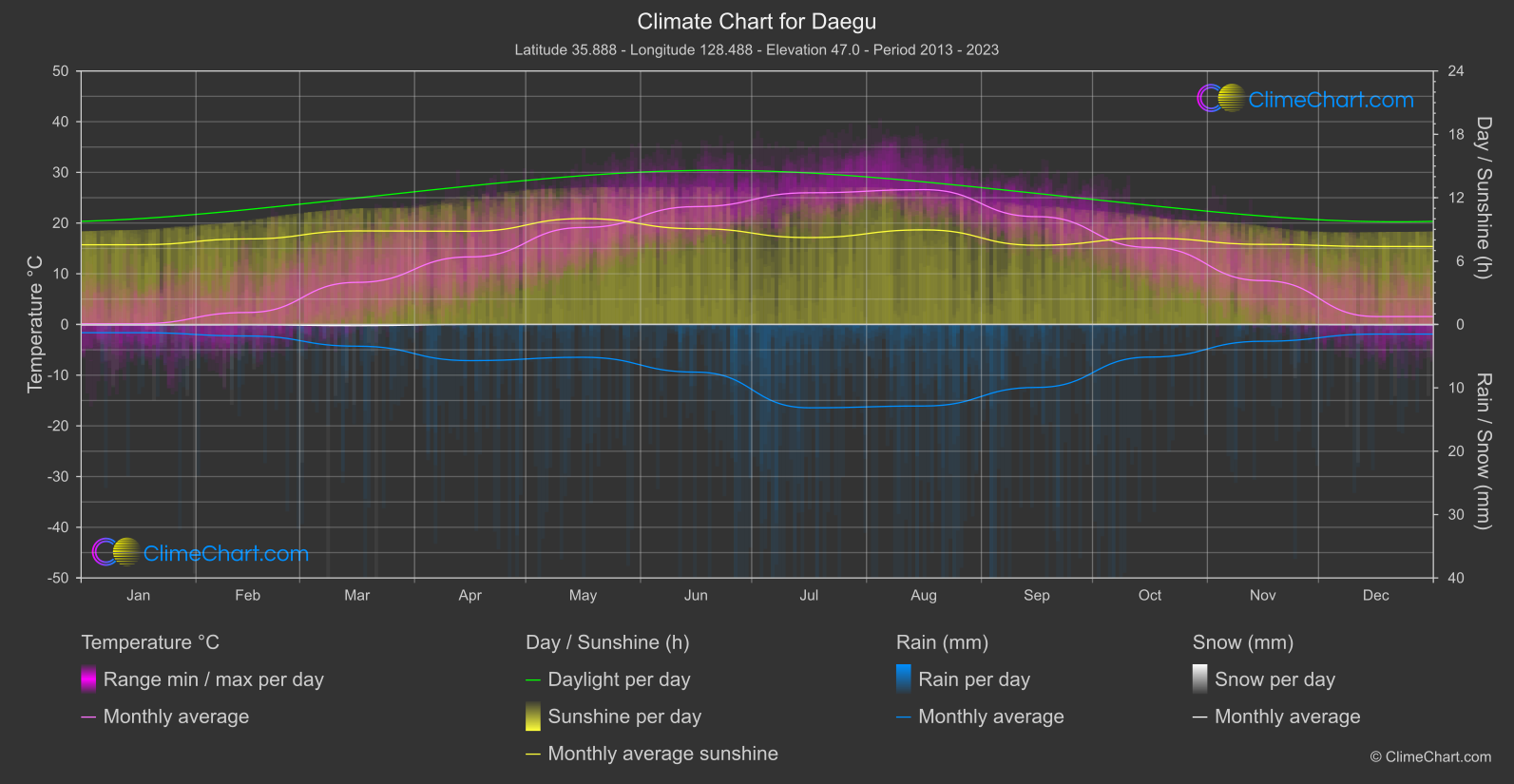
For Daegu, South Korea, the climate data describe 2013–2023. The monthly mean temperature ranges from January at 0.1 °C to August at 26.6 °C, framing a year with a clear contrast between its coolest and warmest monthly averages. Rainfall and sunshine also vary across the calendar, while recorded snowfall is present in the monthly data. These averages offer a broad planning picture, but do not describe the conditions of any particular day.
Climate overview
Temperature
The coolest monthly mean temperature occurs in January, at 0.1 °C; the warmest occurs in August, at 26.6 °C. These are averages for the whole month, not daytime highs, so they provide a seasonal-scale reference rather than a forecast of afternoon conditions. The unweighted mean across monthly means is 13.8 °C, a compact summary that does not give greater weight to longer months.
Rain
Mean daily rainfall is lowest in January, at 0.65 mm/day, and highest in July, at 6.58 mm/day. These figures describe average daily amounts within each month, not monthly totals, and they do not reveal how often rain falls or guarantee dry or wet days. The unweighted mean of the monthly values is 2.93 mm/day; visitors should still allow for day-to-day variation when making plans.
Sunshine
Average daily sunshine reaches its highest value in May, at 10.02 hours/day, and its lowest in December, at 7.38 hours/day. This can help with broad outdoor-planning expectations, though sunshine duration is not the same as day length and does not guarantee clear skies on a particular date. The unweighted mean across monthly sunshine averages is 8.35 hours/day.
Snow
The highest monthly mean daily snowfall is recorded in March, at 0.96 mm/day; the unweighted mean across monthly means is 0.16 mm/day. These daily averages do not establish how many days receive snow, how deep it becomes, whether snow cover persists, or whether conditions suit skiing.
Best Travel Time Guide for Daegu, South Korea: Ideal Seasons and Weather Insights
If lower average rainfall is a priority, January is the conditional option in the monthly data, with mean daily rainfall of 0.65 mm/day; this does not guarantee dry days or indicate how frequently rain occurs. For visitors prioritising cooler monthly averages, January is the relevant reference, with a mean temperature of 0.1 °C. These are separate criteria rather than a single best-time ranking. Rain preparation is particularly relevant for July, when mean daily rainfall is 6.58 mm/day; the average is not a forecast for your travel dates, so flexible plans and rain protection are sensible. For outdoor sightseeing planned around sunshine, the monthly mean is highest in May at 10.02 hours/day, while the lowest is in December at 7.38 hours/day. Sunshine duration can inform broad expectations, but it is not day length and cannot promise clear conditions.
Snowfall planning should remain cautious: the highest monthly mean daily snowfall is 0.96 mm/day in March. This amount does not show the number of snowy days, snow depth or persistence, so it cannot establish likely ground conditions for a particular visit.
Climate Data Overview for Daegu, South Korea
Explore the comprehensive climate data for Daegu, South Korea. This detailed table provides valuable insights into temperature variations, precipitation levels, and seasonal changes, helping you understand the unique weather patterns of this region.
| Month | Average: Temperature °C | Rain (mm) / day | Snow (mm) / day | Sunshine (h) / day |
|---|---|---|---|---|
| Jan | 0.1 | 0.65 | 0.40 | 7.55 |
| Feb | 2.4 | 0.91 | 0.28 | 8.10 |
| Mar | 8.3 | 1.71 | 0.96 | 8.86 |
| Apr | 13.3 | 2.85 | 0.00 | 8.82 |
| May | 19.1 | 2.59 | 0.00 | 10.02 |
| Jun | 23.2 | 3.76 | 0.00 | 9.07 |
| Jul | 26.0 | 6.58 | 0.00 | 8.23 |
| Aug | 26.6 | 6.43 | 0.00 | 8.96 |
| Sep | 21.3 | 4.97 | 0.00 | 7.50 |
| Oct | 15.2 | 2.57 | 0.00 | 8.17 |
| Nov | 8.6 | 1.33 | 0.03 | 7.58 |
| Dec | 1.6 | 0.76 | 0.27 | 7.38 |
| Average | 13.8 | 2.93 | 0.16 | 8.35 |